![]() What is 6-Moly?
What is 6-Moly?
6-Moly alloys are Superaustenitic stainless steel alloys named for their 6% Molybdenum content. They are highly resistant to corrosion and stress cracking and are up to 50% stronger than conventional stainless steels. Enhanced levels of two key elements, chromium and molybdenum, plus the addition of nitrogen give these alloys greatly improved pitting and crevice corrosion resistance in chlorides. Therefore making 6-Moly Alloys well suited for high chloride environments such as brackish water, seawater, pulp mill bleach plants and other high chloride process streams.
Find out more about Swagelok's 6-Moly alloy product offering.
-
What are the characteristics of 6-Moly Alloys?
-
Highly resistant to pitting, crevice and general corrosion.
-
Very high resistance to chloride stress corrosion cracking
-
50% stronger than 300-series austenitic stainless steels
-
Excellent impact toughness
-
Excellent workability and wedablilty
-
Chemical Composition
|
Alloy |
UNS |
Ni |
Cr |
Mo |
Cu |
N |
|
254 |
S31254 |
17.5-18.5 |
19.5-20.5 |
6.0-6.5 |
0.50-1.00 |
0.18-0.22 |
|
6HN,6XN, 25-6HN |
N08367 |
23.5-25.5 |
20.0-22.0 |
6.0-7.0 |
0.75 max. |
0.18-0.25 |
Corrosion resistance of 6-Moly alloys
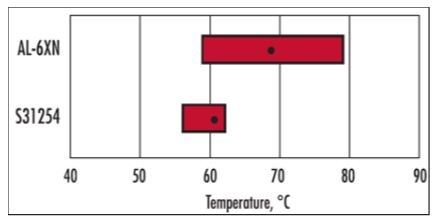
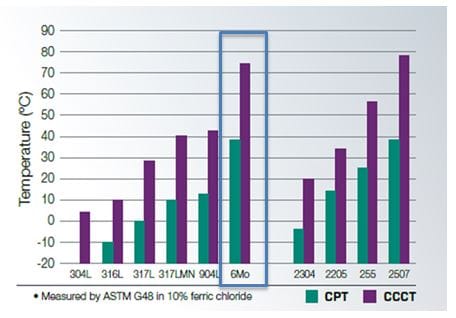
Critical crevice corrosion temperature (CCCT) is the minimum temperature at which crevice corrosion is observed.
CPT values are the lowest temperatures at which pitting corrosion attack.
Since the basic corrosion mechanism is the same for both pitting and for crevice corrosion, the same elements are beneficial in combating both types of corrosion attack. Due to this, there is often a direct correlation between the CPT- and CCT-values for a certain steel grade.
The figures below shown compares the critical crevice corrosion temperature (CCCT) for each 6% Moly alloy. These were determined by 3 tests run in 3% NaCl to compare each grade's suitability for use in seawater applications in the North Sea. The band shows the range of results, while the dot shows the average of the three tests. Also shown are the average values of four tests measuring the critical pitting temperatures on welded specimens in the same evaluation.
Not all 6-Moly is the same
NORSOK M-630 Piping Data standard lists at least two 6-Moly alloys.
Traditionally Swagelok has used 254 6-Moly but through our latest manufacturing developments and material sourcing, we can now offer 6HN 6-Molydenum.
|
Alloy |
UNS |
Ni |
Cr |
Mo |
Cu |
N |
|
254 |
S31254 |
17.5-18.5 |
19.5-20.5 |
6.0-6.5 |
0.50-1.00 |
0.18-0.22 |
|
6XN, 6HN 25-6HN |
N08367 |
23.5-25.5 |
20.0-22.0 |
6.0-7.0 |
0.75 max. |
0.18-0.25 |
6HN versus 254
6HN has 6% higher Ni content, Higher CR and lower CU content. This provides several advantages as outlined in our :-
- Better crevice corrosion resistance
- More resistant to Sigma phase formation
- Improved mechanical properties
- Higher ASTM temperature rating
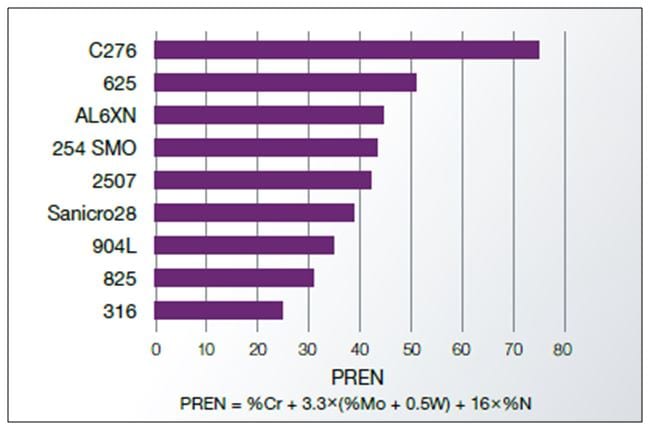
The Pitting Resistance Equivalent Number (PREN) is an industry recognized way to determine the corrosion resistance of a material.
The chart below shows that 6XN is more corrosive resistant than 254 due to the higher Cr content.